Most students pick a career the same way they pick a movie on Netflix: they look at what’s "trending" and hope for the best. But a career isn't a two-hour rom-com. It’s a 40-year investment.
The old-school model of "pick a degree, get a job, stay for life" is dead. We are entering an era of extreme personalisation where traditional "one size fits all" advice actually does more harm than good. If you are following a roadmap designed in 1995, you are heading toward a dead end. Here’s why personalised career guidance is no longer a luxury. It’s a survival mechanism.
Book Your Personalised Career Guidance and Counselling Now!
In this blog, we look at practical strategies used in students career guidance that help students plan their future with clarity and confidence.
Why Personalised Career Guidance Matters for Students
Students today are paralysed by Decision Fatigue. When you can be anything, you often end up being nothing because the fear of choosing the "wrong" path is louder than the excitement of choosing the right one. If your career strategy is the same as everyone else's, you are effectively invisible to the market. Personalisation is really important now. It is the way to do things correctly. We need personalisation to get on the track.
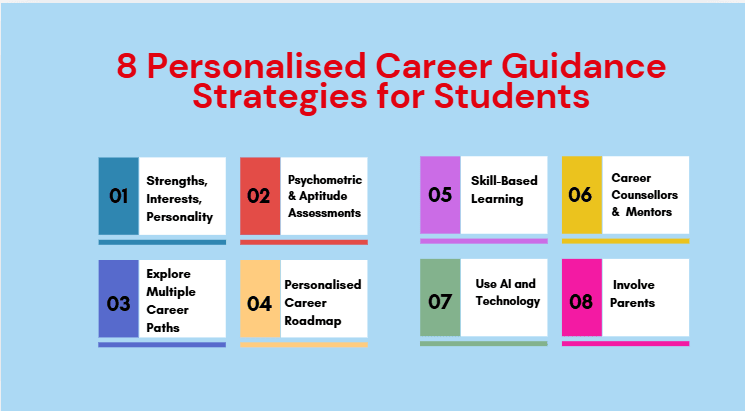
8 Personalised Career Guidance Strategies for Students
Choosing a career path requires more than general advice. Every student has different interests, strengths, and goals. Because of this, personalized career guidance for students helps students identify suitable academic paths and build the skills needed for their chosen profession.
Good career guidance and counselling focuses on understanding each student individually. The strategies below make students' career guidance more practical and useful.
Strategy 1: Start With Strengths, Interests & Personality
- Understanding Individual Learning Styles
We’ve been conditioned to think that if you aren't good at sitting still and reading a textbook, you aren't "academic." That’s a massive business loss for the future workforce.
- Personalised guidance helps figure out if a student's a Kinesthetic learner, which means they learn by building things or a Visual learner, which means they learn by seeing the information or an Auditory learner, which means they learn by listening to the information, about Kinesthetic learners, Visual learners and Auditory learners.
- Importance of Personality-Based Career Planning
You can teach a fish to climb a tree, but you’ll waste years of tuition and end up with a very depressed fish. Skills are just tools. Personality is the operating system.
- Tools to Assess Strengths and Interests
A tech stack for self-discovery:
- Interest Inventories
- Strength-Finders tools
- Shadowing & Micro-Internships tool
The Insight: Most students don't have a "lack of interest." They have a lack of exposure. You can’t be interested in something you don’t know exists. Strategy #1 is about widening that lens before the world tries to narrow it.
Strategy 2: Use Psychometric & Aptitude Tests
Psychometric assessments are designed to see how your brain actually processes the world.
What Are Psychometric Tests?
These tests reveal how your brain is actually wired to process the world. They don't care if you can recite historical dates or solve for X. Instead, they measure the invisible "operating system" running in the background: your cognitive processing speed, your emotional intelligence (EQ), and the specific logic patterns you use to navigate chaos. In a modern business context, this data is the ultimate career cheat code.
How Aptitude Assessments Help Students
Aptitude isn't about what you know; it’s about your "natural ceiling." If a student has a high spatial aptitude but is struggling in a standard English-heavy curriculum, they might feel "unintelligent." An aptitude assessment flips that script. It might reveal that they have the mental architecture of a world-class Engineer or an Architect.
The assessment provides a Permission Slip to stop trying to be good at everything and start being exceptional at the things that come naturally. It moves the conversation from "I hope I'm good enough for this job" to "This career path is mathematically aligned with my strengths."
Key Areas These Tests Evaluate:
- Numerical Reasoning (The "Pattern" Hunter)
This isn't about being a human calculator. It’s about your ability to see a mess of data and instinctively spot the trend.
- Verbal Reasoning (The "Nuance" Detective)
Can you read between the lines? This evaluates how you navigate complex information and logic in communication.
- Abstract Reasoning (The "Chaos" Solver)
This is the ultimate "innovation" trait. It tests how you solve problems when there is no manual to follow.
If you’re a high-scorer in abstract reasoning, you’re built for the "what if" roles—the ones that create new products and disrupt old industries.
The Prediction: In the next three years, your "Aptitude Score" will become more valuable than your GPA. Companies would rather hire a student with high abstract reasoning and a "B" average than an "A+" student who can only follow instructions.
Strategy #2 is about figuring out which of these engines is powering your brain before you start driving toward a career.
Strategy 3: Explore Multiple Career Paths First
The biggest mistake students make is committing to a path before they’ve even looked at the map. In a world where the average person will change careers five to seven times, "picking one thing" isn't just stressful; it’s mathematically risky. You don’t need a decision yet; you need a portfolio of possibilities.
- Why Career Exploration Is Important
If you only know one path and that industry gets disrupted by AI or a market shift, you’re stuck. If you’ve explored three related paths, you have "pivot power."
- Emerging Career Opportunities Students Should Know
The job market is currently in a state of "The Great Re-Shuffling." Roles that didn't exist three years ago are now the most lucrative.
- Traditional vs Modern Career Options
The old world was Linear. You studied Law to be a Lawyer. You studied Accounting to be an Accountant.
The new world is Modular
Traditional careers focus on titles (Doctor, Engineer, Banker). Modern careers focus on problems (Healthcare Tech, Sustainable Infrastructure, Fintech Systems).
The modern approach is "Business-First."This shift changes everything. It turns a "Law degree" into a "Legal Tech Strategy" career. It turns an "Art degree" into a "Digital Asset Management" career.
Strategy 4: Build a Personalised Career Roadmap
Most students treat their career like a GPS-less road trip. They start driving because they feel like they should be moving, only to realise three years later they’ve arrived in a city they never actually wanted to visit.
A "roadmap" isn't a rigid contract; it’s a living document that turns vague anxiety into a sequence of logical moves. Without one, you aren’t "exploring"—you’re just drifting. And in a high-speed economy, drifting is the most expensive thing you can do.
- Aligning Academic Choices With Career Aspirations
Every class should be seen as a building block for your plan. You should think of your classes as part of your roadmap. - Building a Step-by-Step Career Plan
The real winners are the students who have a "portfolio of evidence". Don't tell an employer you’re a "hard worker." Show them evidence of your work. - Tracking Progress and Updating Goals
The biggest mistake you can make? Treating your roadmap like it’s carved in stone. The market changes, and more importantly, you change. In a high-speed economy, a "set it and forget it" career plan is no longer practised. Your roadmap must be Iterative.
Strategy 5: Focus on Skill-Based Learning
Your certificate tells them you showed up. Your skills tell them you're worth keeping.
- Why Skills Matter More Than Marks Alone
Skills provide immediate utility. You don't need a hundred skills. You need a "Power Stack" that makes you hard to replace.
- Important Future-Ready Skills for Students
The "Power Stack": 3 Skills That Make You Irreplaceable. You don't need a hundred mediocre skills. You need a specific stack that makes you mathematically hard to replace.
- Data Fluency (The Storyteller)
This isn't about being a math genius. It’s about looking at a chaotic spreadsheet and finding the "why." If you can see the story behind the numbers, you aren't just an employee. You’re a forecaster.
- Adaptive Intelligence (The Unlearner)
The most dangerous thing you can be in 2026 is "the expert in how things used to be." The real winners are those who can unlearn an old workflow the second a better tool, like AI, arrives.
- High-Stakes Communication (The Simplifier)
Complexity is easy. Simplicity is hard. If you can explain "Quantum Computing" or a "Tax Merger" to a five-year-old, you can lead any boardroom in the world.
Strategy 6: Get Guidance From Counsellors & Mentors
- Role of Career Counsellors in Student Success
A professional career counsellor acts as a Pattern Recogniser. They look at your psychometric data, your interests, and the current market shifts to identify "Hidden Opportunities" that you didn't even know existed. They bridge the gap between academic theory and economic reality. They turn your "I think I’m good at this" into "Here is the data that proves you’ll thrive in this specific sector".
- How Mentors Provide Career Direction
While a counsellor provides the map, a mentor provides the Street Intelligence. A mentor is someone already in the trenches. They can tell you which certifications are actually respected and which ones are just expensive pieces of paper. They offer "Tacit Knowledge"—the unwritten rules of an industry that you won't find in a textbook.
- When Students Should Seek Professional Guidance
You should seek professional help when you feel "The Pivot Tension." This is that moment when your current academic path starts to feel misaligned with the person you are becoming. If you are choosing your senior secondary subjects or your college degree based on "vibes" rather than a strategy, that is your signal to get a pro in the room.
- Choosing the Right Career Guidance Expert
Not all advice is created equal. To avoid the "Bad Advice Trap," you need to vet your experts using a business-first mindset:
- Check the Data Stack: Do they use modern psychometric tools, or are they just giving "follow your heart" speeches?
- The "Proof of Success": Have they successfully guided students into modern, non-linear paths, or do they only know how to suggest Law, Medicine, and Engineering?
Strategy 7: Leverage AI for Career Guidance
If you’re still thinking of AI as just a chatbot that writes mediocre essays, you’re missing the biggest shift in career engineering. AI is about giving the human element a superpower.
- How AI Is Changing Career Counselling
Traditional counselling often feels like looking through a rearview mirror. It tells you what worked five years ago. AI, however, looks at the road ahead. It removes the "I think" and replaces it with "The data suggests."
- Benefits of AI-Based Career Guidance Platforms
Most guidance platforms now offer:
- Real-Time Market Mapping: While a textbook says "become a software engineer," AI points out that "Fintech Security" in Southeast Asia is currently undersupplied and high-paying.
- Simulation & Forecasting: Some platforms now allow students to "test drive" a career through AI-simulated work tasks.
- Combine Human Guidance With AI: The "Winner’s Strategy" isn't Human vs. AI. It’s Human + AI.
Strategy 8: Include Parents in Career Decisions
Parents are a student's first career advisors — whether they know it or not. Every conversation at home, every reaction to a report card, every "you should be a doctor" quietly shapes how a student sees their future. So why leave parents out of the formal career planning process?
Bringing parents in — the right way — makes a real difference.
- Balancing Student Interests and Family Expectations
This is where most families hit a wall. The student wants to study design. The parents want medicine. Nobody's wrong — they just want different things. The fix isn't choosing a side. It's finding the shared value underneath: security, impact, a good life.
Why invest4Edu is the Right Partner for Career Guidance?
Choosing the right career path requires the right guidance at the right time. With structured support and expert advice, students can make confident decisions about their education and future profession. invest4Edu provides personalized career guidance for students that helps them identify their strengths, understand career options, and plan their academic journey clearly.
Through expert-led career guidance and counselling, students receive practical advice, reliable assessments, and step-by-step support that makes career planning easier and more effective.
How invest4Edu Supports Students In Their Career Journey
- Personalized Career Assessments: Students receive a online psychometric assessments that help identify their interests, abilities, and strengths, forming the foundation for effective students career guidance.
- Expert Career Counselling: Experienced counsellors provide professional career counselling that helps students evaluate career options and choose the right academic path.
- Structured Career Planning: Students receive clear guidance on subject selection, higher education options, and career pathways through well-structured career guidance and counselling.
- Access to Online Counselling: With online counselling for career guidance, students can connect with experts and receive personalized advice from anywhere.
- Continuous Career Support
Students receive ongoing guidance and mentorship to help them stay focused on their career goals and make informed decisions at every stage.
Conclusion
The most successful professionals of the future won't be those with the most prestigious titles. They will be the ones who "sampled" five different industries before they turned twenty. Exploration is the new Expertise. invest4Edu focuses on the above personalised career guidance strategies, which are designed to help students understand their strengths, explore suitable career options, and make informed decisions with clarity and confidence.
Don’t choose a career based only on trends or pressure. Call 85918 58565 for personalised career guidance that actually fits you.