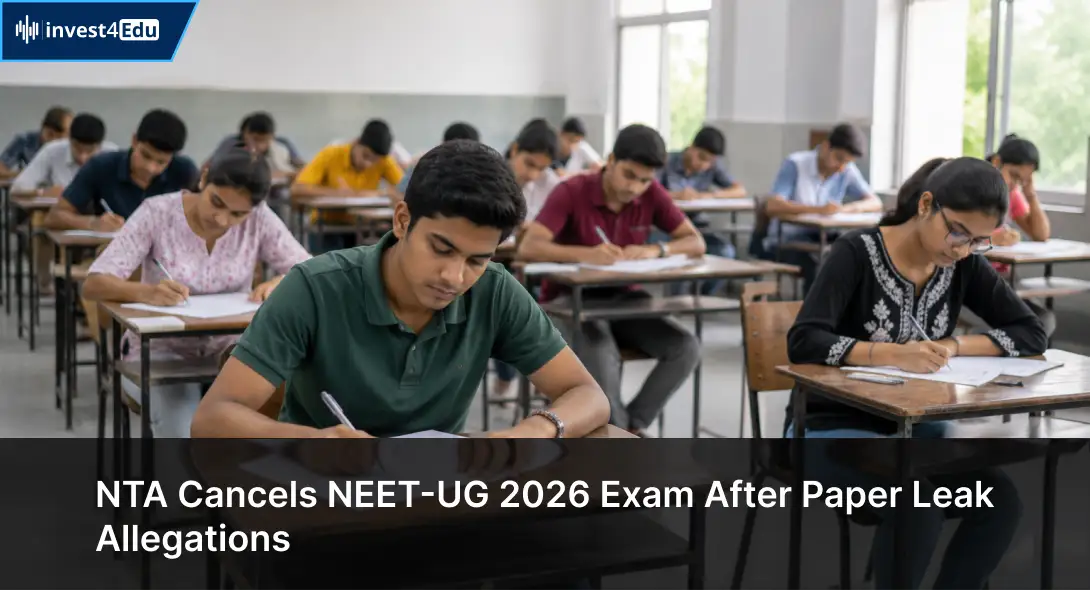
More than 22 lakh students have been preparing for NEET UG 2026 for months — some for years. Then, suddenly, the entire exam was cancelled after allegations of a paper leak and inputs from central agencies into the investigation. The government has now ordered a CBI probe, and a fresh NEET exam is expected.
And here’s the part most people are missing.
The biggest damage is not only academic. It’s psychological. Because when India’s largest medical entrance exam gets cancelled after students spend years preparing for it, students stop worrying only about ranks. They start questioning whether the system itself is reliable. That changes everything.
So the next question is obvious: what exactly triggered a nationwide cancellation of India’s biggest medical entrance exam?
NTA Cancels NEET UG 2026, Fresh Exam Dates Soon
Official cancellation notice issued by the National Testing Agency (NTA) for NEET UG 2026, confirming that the exam held on May 3, 2026 has been cancelled due to alleged irregularities including a paper leak
The NEET UG 2026 exam conducted on May 3 has been cancelled following inputs and investigative findings reviewed in coordination with central agencies. The National Testing Agency (NTA) will announce new exam dates soon, and students will not be required to register again or pay any additional fees. The matter has also been referred to the Central Bureau of Investigation (CBI) for a detailed probe into the alleged malpractices.
Why Was NEET UG 2026 Cancelled?
The National Testing Agency (NTA) officially cancelled the NEET UG 2026 exam conducted on May 3 after investigations raised concerns about the integrity of the examination process. The matter has now been handed over to the CBI for further investigation.
According to reports, investigative agencies found possible evidence linked to question paper leaks and organised malpractice networks.
And this is where things get bigger than just one exam.
Because NEET is not a small competitive test anymore. It’s one of the largest educational filtering systems in the world. One disruption affects:
- Medical admissions
- Counselling schedules
- Coaching ecosystems
- State quotas
- Private colleges
- Student mental health
- Parental financial planning
That’s why the cancellation triggered national outrage almost instantly.
What Exactly Did NTA Announce?
The NTA confirmed that:
- NEET UG 2026 has been cancelled
- A re-exam will be conducted
- Fresh dates will be announced separately
- Students do not need to register again
- Existing application data will remain valid
- No additional exam fee will be charged
Alleged Malpractice Links & Telegram Leak
Reports of suspected malpractice in Rajasthan’s Sikar region quickly became a major focus of the NEET controversy, with early investigations hinting at possible irregularities involving certain centres and coaching-linked networks. The situation escalated when alleged Telegram videos, screenshots, and question documents claiming to be from the leaked paper began circulating widely online.
The NTA said it received inputs about these activities on May 7 and escalated them to central agencies the next day for verification. Soon after, the Rajasthan Special Operations Group (SOG) began its own investigation, with detentions and media reports adding further pressure on authorities.
Although the NTA highlighted its strict security measures—GPS-tracked paper transport, AI-based CCTV monitoring, biometric checks, and 5G jammers—it ultimately concluded that the exam process “could not be allowed to stand,” leading to the nationwide cancellation.
Why Students Are So Angry Right Now
Most people think students are angry because they have to write the exam again. That’s only part of the story. The deeper frustration is uncertainty. Because NEET preparation is already emotionally exhausting:
- Long study hours
- Repeat attempts
- Coaching pressure
- Family expectations
- Financial stress
- Rank anxiety
And now there’s a new layer of worry: “What if the system fails again?” That question is creating a major psychological shift across the NEET ecosystem, amplified even further by social media. Students are no longer just discussing preparation strategies—they’re openly questioning the NTA’s credibility, the security of exam systems, the handling of question papers, and the overall fairness of national-level entrance tests. The conversation has moved from academics to something much deeper: institutional trust.
The Bigger Problem Nobody Wants to Discuss
India’s competitive exam system has grown too large for its outdated processes. NEET is no longer just an exam—it has become an industry, a coaching ecosystem, and a high-stakes national ranking system. When so much pressure and money are involved, even small vulnerabilities become serious risks. That’s why paper leaks now trigger huge reactions. One compromised paper can affect ranks, admissions, scholarships, counselling, and entire career timelines. This is why the 2026 cancellation feels far bigger than a routine exam issue.
Why This Situation Feels Different From Previous NEET Controversies
The 2024 NEET controversy has already damaged public confidence in the exam system. But 2026 feels more serious for one reason. This time, the exam itself was cancelled nationwide. That changes the scale completely. And here’s where things get interesting. Once students lose trust in a national entrance exam, rebuilding credibility becomes extremely difficult.
Because students prepare for NEET with a very simple assumption: “If I work hard enough, the system will remain fair.” The moment that belief weakens, the emotional foundation of competitive exams starts cracking. That’s the real crisis here.
Supreme Court Petitions And Demand To Replace NTA
The controversy has already reached the Supreme Court. Several petitions are now demanding:
- A fresh exam under judicial supervision
- Structural reforms
- Replacement or overhaul of NTA
- Stronger examination security systems
Medical associations have now entered the debate publicly, creating another major shift in how the issue is being perceived. The conversation is no longer limited to students alone—doctors, legal experts, education activists, coaching communities, and even parents are now questioning how India conducts its biggest entrance exams. As a result, the controversy has expanded far beyond NEET itself, raising broader concerns about the integrity and reliability of the national examination system.
What Happens Next for NEET UG 2026 Students?
Right now, students are waiting for:
- Fresh exam dates
- Revised admit card instructions
- Updated preparation timelines
- Counselling schedule clarity
But here’s the strategic reality students should understand. The re-exam will likely create:
- Even higher competition pressure
- More unpredictable rank movement
- Stronger mental fatigue
- Another intense preparation cycle
Why?
Because students now have extra preparation time. And in competitive exams, extra preparation time often increases score clustering at the top. That could make rank inflation even more aggressive during the re-test. Most students are not thinking about this yet. But they should.
Will This Change How India Conducts Entrance Exams?
Possibly. And honestly, it probably has to. Because the current NEET controversy exposes a larger structural problem. India’s examination ecosystem is scaling faster than its security systems.
That creates pressure for:
- Digital monitoring
- Encrypted paper systems
- Tighter logistics
- AI-based surveillance
- Stronger accountability mechanisms
The bigger shift is this:
Students no longer want only difficult exams. They want trustworthy exams. That expectation will likely shape future education reforms more aggressively after 2026.
What Students Should Do Right Now
This is the hardest part emotionally. Many students feel mentally exhausted after hearing about the cancellation. But strategically, students should avoid panic-based preparation decisions.
The smartest approach right now is:
- Continue revision cycles
- Avoid overconsuming social media speculation
- Wait for official NTA announcements
- Maintain preparation consistency
- Focus on mental stability
Because uncertainty punishes emotional reactions faster than academic weakness. And this phase is now becoming a psychological endurance test as much as an academic one.
Conclusion
NEET UG 2026 cancellation is not just another education headline. It’s a signal that India’s competitive exam ecosystem is entering a much more fragile and high-pressure phase. The real issue is no longer only paper leaks. Its credibility.
And once students begin questioning the credibility of national exams, every future controversy becomes bigger, louder, and more emotionally charged. The next few weeks will decide more than just re-exam dates. They may decide how students trust India’s examination system going forward.
If you need help understanding colleges, counselling rounds, cutoff trends, or realistic MBBS options based on your score, explore Invest4Edu NEET UG/PG Admission Counselling or call us at 85918 58565 for personalised guidance.