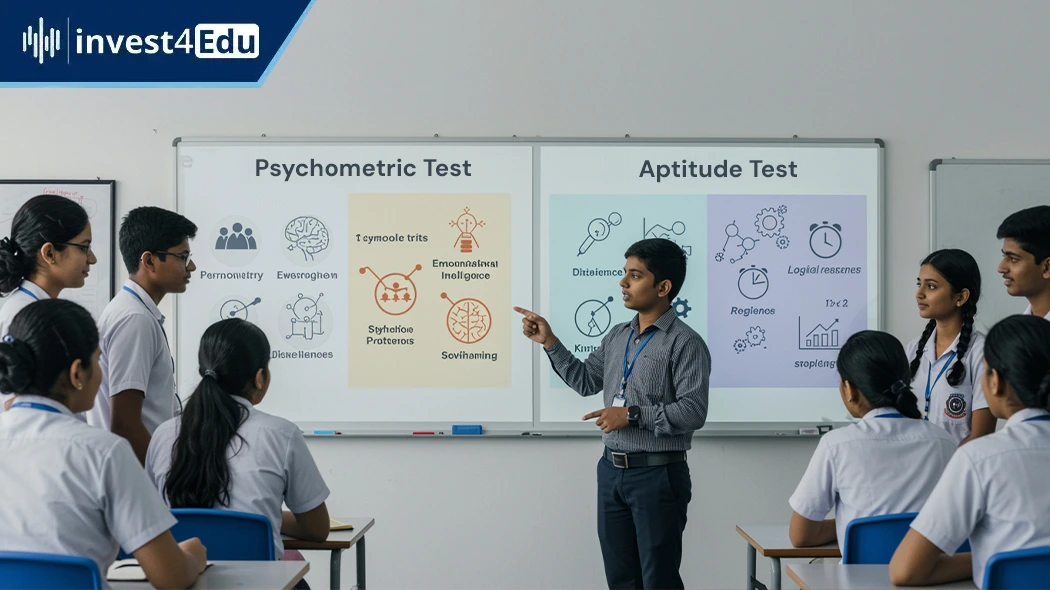
In today's competitive academic and professional environments, understanding one's natural abilities, personality traits, and cognitive strengths is not just important; it's empowering. Psychometric and aptitude tests play a crucial role in this area, serving as powerful tools for self-discovery, career planning, hiring, and educational placement.
Although the terms psychometric tests and aptitude tests are often used interchangeably, they have different purposes and scopes. Understanding these differences is key to making data-driven decisions, whether exploring personal growth, streamlining hiring processes, or, most importantly, aligning talent with the right opportunities.
This blog will take you through everything you need to know about psychometric and aptitude tests—from what they measure and how they differ to the types of tests available and how to interpret results. You'll also learn why using both assessments is beneficial and essential for gaining a more complete picture of potential, performance, and personal fit.
What Are Psychometric Assessment Tests?
Psychometric assessment tests are scientific tools used to evaluate an individual's mental capabilities and psychological traits in a structured and reliable manner. These tests provide valuable insights into how a person thinks, feels, behaves, and responds in different situations—going beyond what traditional academic exams or interviews can reveal.
What does the Term "Psychometric" Means?
The term “psychometric” comes from psychology and refers to the measurement of mental abilities and behavioural patterns. These assessments help build a holistic profile of an individual by analysing various psychological attributes, which can guide informed decisions related to career, education, and personal growth.
Why Psychometric Tests Are Used ?
Psychometric tests are widely used for various purposes, such as:
- Career Counselling: Helps students and professionals identify careers aligned with their personality, interests, strengths, and values.
- Educational Guidance: Assists in stream or subject selection based on natural aptitude, cognitive skills, and learning style.
- Recruitment & Hiring: Enables employers to assess candidates for cultural fit, problem-solving ability, emotional intelligence, and role suitability beyond academic qualifications.
- Employee Development: Used in corporate settings to guide leadership development, team building, and internal promotions.
- Personal Growth & Self-Awareness:Helps individuals gain insights into their decision-making styles, emotional responses, and interpersonal behaviours, which contribute to overall personal and professional growth.
They help answer important questions like:
- What kind of work environment suits you best?
- How do you react to stress or teamwork situations?
- What are your strengths in communication, logic, or creativity?
What Psychometric Tests Measure ?
Psychometric assessments evaluate multiple aspects of an individual’s psychological profile, including:
- Personality Traits
Identify consistent behaviour patterns and how a person interacts with others. - Cognitive Strengths
Measure mental abilities such as logical reasoning, memory, and problem-solving. - Motivation and Values
Understand what internally drives an individual’s choices, actions, and long-term goals. - Emotional Intelligence
Assess the ability to recognise, manage, and respond to one’s own emotions and the emotions of others. - Decision-Making Styles
Reveal how an individual approaches challenges, handles pressure, and makes important choices.
Types of Psychometric Tests:
Psychometric tests are powerful tools used to understand a person’s mental abilities, emotional patterns, personality traits, and motivation. Whether you're a student planning your career path or someone seeking self-awareness, these assessments provide reliable insights that go far beyond traditional academic scores.
Here are the main types of psychometric tests and how they help:
1. Personality Assessments
Personality assessments are tools used to identify your core behavioural traits—such as whether you're more introverted or extroverted, detail-focused or big-picture oriented, and how you typically react to stress and social situations. These tests don’t label you as “good” or “bad,” but instead offer insight into how you naturally think, feel, and interact with the world.
What It Measures
Personality assessments are based on widely accepted psychological models:
- Myers-Briggs Type Indicator (MBTI): Categorises individuals into 16 personality types using four key preferences—Introversion vs. Extraversion, Sensing vs. Intuition, Thinking vs. Feeling, and Judging vs. Perceiving.
- Big Five Personality Theory (OCEAN Model): Measures five broad dimensions of personality—Openness, Conscientiousness, Extraversion, Agreeableness, and Neuroticism.
Why It Matters
- Helps match your personality traits with ideal career paths, roles, and work environments
- Aids in academic stream or subject selection based on natural strengths and preferences
- Enhances self-awareness and builds emotional intelligence, supporting better relationships, communication, and overall personal growth
2. Emotional Intelligence (EQ) Tests
Emotional Intelligence tests assess your ability to understand, express, and manage emotions—both your own and those of others. EQ is essential in everyday life, especially in academic, social, and professional settings.
What It Measures
EQ tests evaluate emotional and social competencies such as:
- Empathy
- Self-awareness and self-regulation
- Conflict management
- Interpersonal communication
Why It Matters
- Crucial for leadership, teamwork, and managing stress effectively
- Supports personal development and stronger relationships
- A key predictor of long-term career success and workplace adaptability
3. Situational Judgement Tests (SJT)
Situational Judgement Tests present you with realistic scenarios and ask how you would respond. Commonly used in job placements and career assessments, SJTs reveal how you apply judgment and ethics in practical, high-pressure situations.
What It Measures
- Decision-making under pressure
- Emotional reactions in real-life situations
- Ethical reasoning and behavioural judgment
- Teamwork and leadership potential
Why It Matters
- Shows how you respond to challenges and resolve conflicts
- Identifies strengths in problem-solving, team dynamics, and leadership
- Used by universities and employers to assess readiness and fit
4. Motivation and Values Questionnaires
These tools explore your internal drivers—what motivates you, the values you hold, and the goals that shape your actions. Unlike IQ or aptitude tests, they uncover what truly inspires you and helps you thrive.
What It Measures
- Personal Core values
- Intrinsic and extrinsic motivators
- Preferred work and learning environments
- Long-term personal and professional goals
Why It Matters
- Helps align career choices with personal beliefs and passions
- Reveals the kind of environment where you perform best
- Brings clarity in goal-setting and decision-making.
What Are Aptitude Tests?
Aptitude tests are standardised assessments designed to measure a person’s natural ability to perform specific types of tasks or respond to different kinds of problems.
These tests focus on evaluating potential strengths and cognitive abilities rather than knowledge. Unlike academic exams, aptitude tests assess natural cognitive abilities that how quickly and effectively someone can learn, adapt, and solve problems.
What Does the Term "Aptitude" Mean?
The term “aptitude” refers to a person's natural ability or capacity to develop skills in a particular area, such as logical reasoning, verbal communication, numerical analysis, or spatial understanding. In psychological and educational contexts, aptitude tests are used to evaluate how well an individual can acquire new skills or handle specific tasks, helping identify strengths and growth areas.
Why Aptitude Tests Are Used?
Aptitude tests are widely used across academic, professional, and recruitment settings for the following purposes:
- Career Counselling:
Helps individuals discover career paths that align with their natural strengths and thinking patterns. - Educational Guidance:
Assists students in selecting suitable academic streams or subjects based on their core abilities and learning styles. - Recruitment & Hiring:
Employers use aptitude tests to evaluate candidates’ problem-solving, critical thinking, and job-specific capabilities, especially for roles requiring analytical or technical skills. - Competitive Exams & Placements:
Many entrance and placement exams include aptitude sections to assess candidate readiness and potential. - Skill Development:
Identifies areas where individuals can improve, enabling targeted training and upskilling.
Aptitude tests help answer key questions like:
- Do you have a natural flair for numbers, words, or logical puzzles?
- How quickly can you grasp new concepts or adapt to new tasks?
- Which fields or careers best match your mental strengths?
Types of Aptitude Tests
Aptitude tests come in various forms, each designed to measure specific mental abilities. Whether you're a student exploring career options or a job-seeker preparing for assessments, understanding these types can help you focus your preparation and uncover your natural strengths. Below are the most common and widely used types of aptitude tests.
1. Verbal Reasoning Test
Verbal reasoning tests assess your ability to understand, interpret, and reason using written language. These are common in academic assessments, corporate hiring, and competitive exams.
What It Measures:
- Reading comprehension
- Grammar and vocabulary usage
- Ability to draw logical conclusions from written information
Why It Matters:
Strong verbal reasoning skills are essential for communication-heavy roles, academic success, and exams that require clear understanding of passages and instructions.
2. Numerical Reasoning Test
This test evaluates how well you work with numbers, data, and mathematical concepts. It’s especially relevant in fields like finance, data science, and engineering.
What It Measures:
- Arithmetic and basic maths operations
- Data interpretation (charts, graphs, tables)
- Logical analysis of numerical information
Why It Matters:
Numerical reasoning reflects your ability to make decisions based on data—crucial for roles that involve budgeting, data analysis, or quantitative research.
3. Logical or Abstract Reasoning Test
Logical reasoning tests (often called abstract reasoning) focus on your ability to identify patterns, solve puzzles, and think critically without relying on language or numbers.
What It Measures:
- Pattern recognition
- Sequencing and spatial relationships
- Logical problem-solving
Why It Matters:
These skills are important for problem-solving, coding, design thinking, and adapting to new situations—traits valued in tech, analytics, and management roles.
4. Mechanical Reasoning Test
Mechanical reasoning tests are used to assess your understanding of basic mechanical and physical principles, commonly required in engineering, technical, and defence roles.
What It Measures:
- Principles of force, motion, levers, pulleys, and gears
- Ability to visualise how mechanical systems work
- Application of physics to real-world problems
Why It Matters:
It helps employers determine if you can work efficiently in technical roles involving machinery, engineering systems, or tools.
5. Spatial Reasoning Test
Spatial reasoning assesses your ability to visualise and manipulate objects, shapes, and patterns in space—useful in design, architecture, and engineering.
What It Measures:
- Mental rotation and visualisation
- Shape recognition and alignment
- 2D to 3D object transformation
Why It Matters:
These skills are essential for fields like graphic design, CAD modelling, architecture, and any role requiring spatial awareness and planning.
6. Data Interpretation Test
Data interpretation tests evaluate how well you can extract useful information from visual data and make logical decisions based on it.
What It Measures:
- Analytical thinking using charts, graphs, and tables
- Decision-making based on statistical information
- Accuracy and speed in reading data
Why It Matters:
These abilities are highly sought-after in data-driven roles like business analytics, marketing, finance, and operations.
7. Inductive Reasoning Test
Inductive reasoning measures your ability to observe patterns, learn rules, and apply them to reach conclusions—a key component of abstract thinking.
What It Measures:
- Identifying similarities or trends
- Applying general rules to new situations
- Predicting outcomes based on logical observations
Why It Matters:
This test is important for strategic thinking, innovation, and learning new concepts—vital in fast-evolving fields like IT, R&D, and consulting.
8. Deductive Reasoning Test
Deductive reasoning tests evaluate your ability to apply known rules or facts to arrive at specific, logical conclusions.
What It Measures:
- Analytical problem-solving
- Rule-based logic application
- Elimination and inference-making
Why It Matters:
Crucial for roles in law, programming, auditing, and roles that require consistent and rule-based decision-making.
What Is the Difference Between Psychometric and Aptitude Tests?
Psychometric tests reveal why you behave the way you do, while aptitude tests determine how well you can perform specific tasks,—making them complementary tools in education, career planning, and recruitment.
|
Feature |
Psychometric Tests |
Aptitude Tests |
|
What They Measure |
Personality traits, values, emotional intelligence, motivation, behavioural styles |
Cognitive abilities, reasoning skills, problem-solving, learning potential |
|
Test Types |
Personality tests (MBTI, Big Five), emotional intelligence, motivation & values, situational judgment |
Numerical, verbal, logical/abstract, spatial, mechanical, data interpretation |
|
Purpose/Use |
Assess soft skills, emotional fit, cultural compatibility, team dynamics |
Identify natural strengths, predict academic or job performance, support career guidance |
|
Preparation Focus |
Self-reflection, emotional awareness, scenario-based responses |
Practising questions, logic puzzles, improving speed and accuracy |
|
Application Fields |
Career counselling, employee assessments, leadership and personal development |
Competitive exams, campus placements, career aptitude and subject stream selection |
|
Evaluation Type |
Subjective (based on traits and behaviours) |
Objective (based on accuracy and speed of solving problems) |
|
Insights Offered |
Helps understand personality, emotions, work style, and interpersonal behaviour |
Helps determine readiness for specific roles or academic paths based on skills |
|
Commonly Used By |
Psychologists, HR professionals, career coaches |
Educators, recruiters, counsellors, exam boards |
|
Nature of Assessment |
Qualitative and descriptive |
Quantitative and performance-based |
|
Testing Format |
Multiple choice, ranking preferences, situational scenarios |
Timed questions, right-or-wrong answers, skill-based tasks |
|
Outcome Usefulness |
Improves self-awareness, communication, emotional control |
Guides subject/career choice, hiring, and entrance exam success |
Unlock Your True Potential with Expert Guidance
Discover your strengths with invest4Edu’s psychometric and aptitude testing
Why Should Organisations Use Both Assessments?
Using both aptitude and psychometric tests offers a more complete understanding of an individual—combining skills evaluation with behavioural insight. Combining both assessments ensures better choices in hiring, education, or counselling—backed by science, not guesswork.
- Smarter Selection and Placement: Aptitude tests reveal cognitive strengths, while psychometric assessments uncover personality traits, emotional intelligence, and motivation. Together, they help ensure the right fit for roles, teams, or academic paths.
- Personalised Development Plans: The combined results allow for tailored learning or career plans—aligning a person's abilities with their behavioural style and growth potential.
- Balanced & Fair Decision-Making: Using both tests reduces bias by balancing performance-based data with personality insights, leading to more objective and well-rounded decisions.
invest4Edu: Your End-to-End Career & Education Partner
invest4Edu offers a 360° support system designed to help students make informed career decisions, build essential skills, and access the resources they need for academic and professional success—backed by expert-driven tools and personalised guidance.
Scientifically designed tests to evaluate personality, cognitive abilities, emotional intelligence, and motivation—helping students understand themselves better and make confident career choices.
Personalised, one-on-one counselling that translates assessment insights into actionable career roadmaps, guiding students on stream selection, course planning, and long-term goals.
3. Skill-Building Programs
Customised modules enhance essential 21st-century skills like communication, critical thinking, leadership, and time management—aligned with each student’s profile.
Extended Support Services
- Education Loan Assistance: Expert help in finding, applying for, and managing loans for both domestic and international education.
- Study Abroad Support: End-to-end help with university selection, SOP writing, applications, and visa counselling.
- Admission Process Counselling: Step-by-step support for medical, engineering, and university admissions—covering NEET, JEE, CUET, and more.
- Personal Finance Services: Guidance on budgeting for education, managing student expenses, understanding financial aid, and planning for long-term academic investments.
- Parent Advisory & Webinars: Resources and sessions to actively involve parents in their child’s education and career journey.
Conclusion
Understanding the difference between psychometric and aptitude tests helps students, parents, and educators make informed choices about assessments and career planning. While aptitude tests measure cognitive strengths, psychometric tests explore personality and emotional traits. When used together, they provide a fuller picture of an individual’s potential. With invest4Edu’s expert-led psychometric assessments, personalised career counselling, and skill-building programs helps individuals to identify their strengths, choose the right career path, enhance essential skills, and confidently work towards academic and professional success.