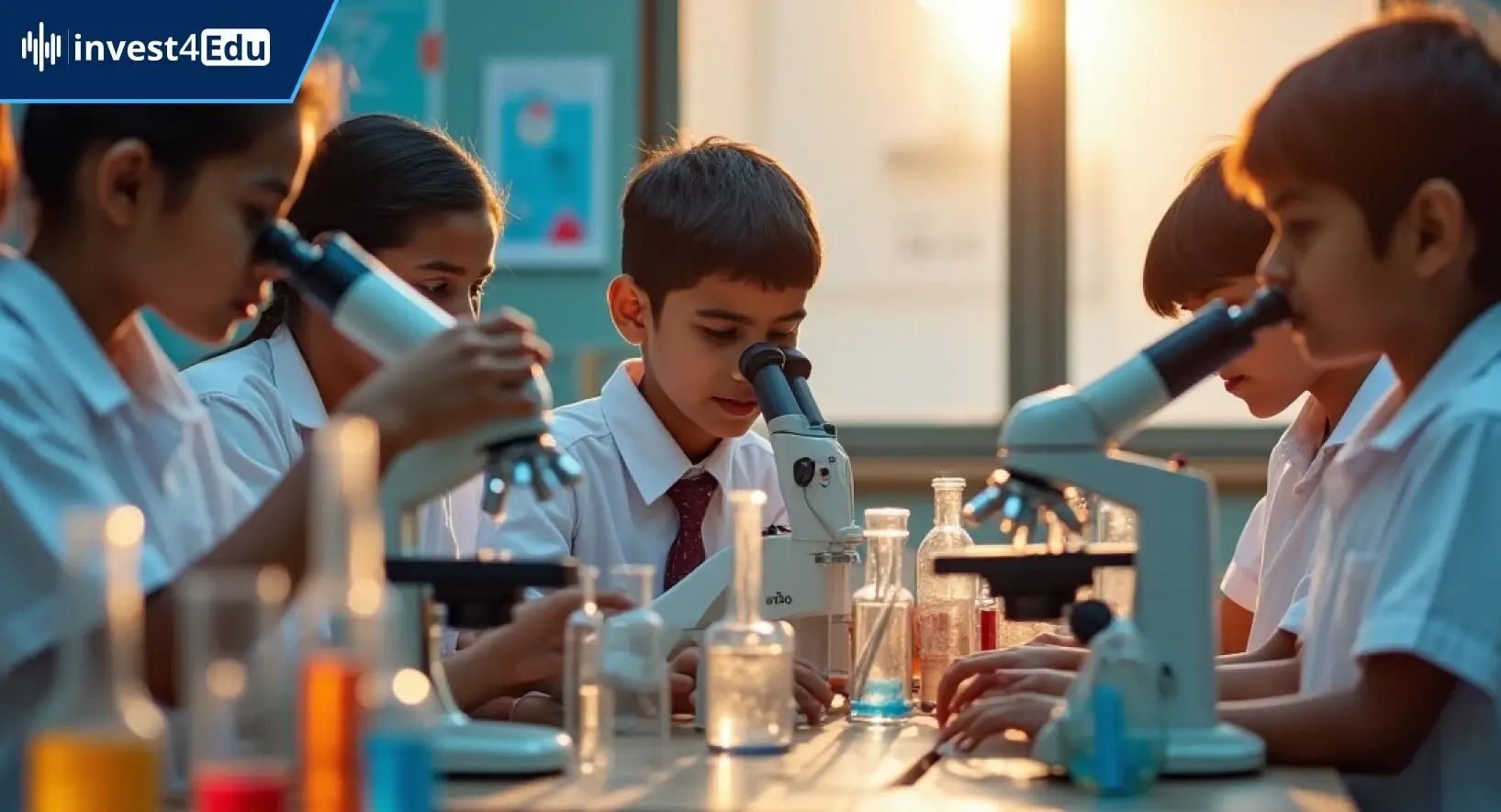
The NSEJS Exam 2025 is one of the most respected national-level science exams for school students in India. Each year, many talented young students take this exam to display their skills in science and earn a spot in the International Junior Science Olympiad (IJSO). If you're wondering about what the NSEJS exam is, what's on the syllabus, how to register, when results come out, where to get the admit card, and where to find past papers, this comprehensive guide has all the information you need about the NSEJS 2025 Exam.
What is the NSEJS Exam?
The full form of NSEJS is National Standard Examination in Junior Science. It is the first step in the Junior Science Olympiad program organised by the Indian Association of Physics Teachers (IAPT). The NSEJS exam is designed for school students of Classes 8-10 to assess their understanding of science, their ability to think logically, and their skill in solving problems. NSEJS offers a national-level opportunity to students who want to participate in the Junior Science Olympiad
Overview on National Standard Examination in Junior Science (NSEJS) - 2025
The NSEJS 2025 is a highly competitive exam designed to identify talented students in science across India. It acts as the first step towards representing the country in the International Junior Science Olympiad.
- Exam Name: National Standard Examination in Junior Science (NSEJS 2025)
- Conducted by: Indian Association of Physics Teachers (IAPT)
- Purpose: To choose students who will represent the country in the International Junior Science Olympiad (IJSO)
- Level: A national-level competition for students studying in schools
- Mode of Exam: Written, Pen & Paper Based
- Medium of Exam: In English and various regional languages
NSEJS 2025–26 Important Dates
Knowing the timeline is essential for proper preparation and timely registration. The exam follows a fixed schedule every year from registration to results.
Here are the proposed tentative dates:
- Start of Centre Registration: 1st August 2025
- End of Centre Registration: 20th August 2025
- Start of Student Registration: 21st August 2025
- End of Student Registration: 14th September 2025
- NSEJS 2025–26 Exam Date: Sunday, 23rd November 2025
- Exam Time: 2:30 PM to 4:30 PM
- Exam Venue: Registered NSE Centres
Note: Visit the IAPT website to timely to get the exact dates and other details .
Eligibility Criteria for NSEJS 2025–26
Eligibility is defined by age, academic level, and nationality. The students who fit into these criteria can only register for the NSEJS exam :
- Class/Grade: Candidates must be enrolled in Class 10 or below during the year 2025.
- Age: Born between 1st January 2010 and 31st December 2011 (tentative; refer to official IAPT updates for confirmation).
- Citizenship: Only Indian citizens are eligible. Overseas Citizens of India (OCI) or Persons of Indian Origin (PIO) are not eligible as per the latest rules.
- No Prior 10th Pass: Candidates should not have passed Class 10 board examinations before 1st November 2025.
- One Stream Only: Candidates cannot register for other NSE exams (NSEA, NSEB, NSEC, NSEP) in the same session.
The above criteria clear that only the right young students can take part in this junior scientist exam.
NSEJS 2025–26 Exam Pattern
Understanding the exam structure helps students plan their preparation strategy. The exam pattern highlights duration, type of questions, and marking scheme.
|
Component |
Details |
|
Total Questions |
60 |
|
Total Marks |
216 |
|
Exam Duration |
120 minutes (2 hours) |
|
Mode of Exam |
Offline (OMR , Pen & Paper based) |
|
Type of Questions |
Multiple Choice Questions (MCQs) |
|
Sections |
A) 48 single-correct questions : +3 for correct, –1 for incorrect |
|
Medium |
English and Hindi (selectable during registration) |
Subject Wise Marks Distribution :
|
Subject |
No. of Questions |
Marks per Question |
Total Marks |
|
Physics |
20 |
3 (+3, –1) |
60 |
|
Chemistry |
20 |
3 (+3, –1) |
60 |
|
Biology |
20 |
3 (+3, –1) |
60 |
|
Mathematics |
20 |
3 (+3, –1) |
60 |
|
Total |
80 |
– |
240 |
NSEJS 2025–26 Syllabus Overview
The NSEJS syllabus is a blend of Physics, Chemistry, Biology, and Mathematics from Classes 8 to 10. It is aligned with the Junior Science Olympiad and IJSO syllabus.
Key Subjects Covered:
- Physics: Topics include motion, laws of motion, heat, light, electricity, magnetism, and sound.
- Chemistry: Topics include atomic structure, chemical reactions, acids and bases, the periodic table, and environmental chemistry.
- Biology: Topics include cell structure, genetics, human body functions, plant life processes, and ecology.
- Mathematics: Topics include algebra, geometry, probability, mensuration, statistics, and arithmetic.
Students can also practice with past NSEJS question papers and previous year papers to get a better understanding of the exam pattern and the level of questions.
How to Register for NSEJS 2025–26
The registration process is simple and can be completed online. Students need to fill in their details, select a centre, and pay the registration fee. To sign up for NSEJS 2025–26, you need to follow these steps:
- Visit the official IAPT registration portal: The registration form is available online at the IAPT portal. Only online applications are accepted.
- Fill in student details such as name, school, date of birth, and class: Ensure that all details entered are accurate. Incorrect information may lead to disqualification later.
- Select your examination centre: Students must choose their preferred exam city from the available list. Seats are allotted on a first-come, first-served basis.
- Upload necessary documents (ID proof, school certificate, etc.): These documents serve as proof of eligibility. Ensure that scanned copies are clear and valid.
- Pay the registration fee online: Payment can be made through digital methods such as net banking, UPI, or cards. This confirms the application submission.
- Registration Fee for NSEJS 2025–26: The cost to register for NSEJS 2025–26 is generally ₹ 300. Students need to pay the fee when they fill out the NSEJS registration form.
- Download and save the confirmation slip: Once the payment is successful, candidates must download the confirmation slip. It acts as proof of successful registration.
NSEJS Exam – Conducted by IAPT
NSEJS is the first step for aspiring young scientists. Only the top performers move on to the next stage before reaching IJSO.
- Indian National Junior Science Olympiad (INJSO): Qualifiers of NSEJS appear for INJSO. This exam further shortlists candidates for the training camps.
- Orientation-cum-Selection Camp (OCSC) in Junior Science: Selected students attend OCSC, where they undergo rigorous training. This camp prepares them for the International Olympiad.
- International Junior Science Olympiad (IJSO): Finally, the top students represent India in IJSO. Winning medals here brings global recognition.
Awards & Recognitions
Students who perform well in NSEJS gain recognition at both national and international levels. The exam opens doors to many academic opportunities.
- Certificates of merit and appreciation: Every student who qualifies receives certificates from IAPT. These certificates add weight to academic portfolios.
- Opportunity to represent India in IJSO: Only a handful of students get the chance to compete internationally. It is considered one of the highest honours for school students.
- Recognition as some of the best young scientists in the country: Success in NSEJS makes students stand out. It highlights their academic potential in science.
- Boost for future academic and research opportunities: Olympiad achievers often find it easier to secure scholarships and gain admission to top institutions. It is a stepping stone to a bright career.
NSEJS 2025–26 Preparation Strategy
A proper study strategy can make preparation easier and more effective. Students must balance concept learning, practice, and time management. To perform well in the NSEJS exam, students should follow these strategies:
- Go through the NSEJS syllabus and the NSE exam syllabus carefully: A structured study plan begins with understanding the complete syllabus. Prioritising topics ensures better time management.
- Solve NSEJS previous year papers and NSEJS question papers regularly: Practising past questions gives insights into exam trends. It also improves speed and accuracy.
- Strengthen concepts in Physics, Chemistry, Biology, and Mathematics: Conceptual clarity is more important than rote learning. Focus on application-based problems.
- Focus on logical reasoning and application-based questions: The exam tests scientific aptitude rather than memorisation. Developing analytical thinking is essential.
- Revise NCERT textbooks from Classes 8 to 10 thoroughly : A majority of the syllabus is based on NCERT content. These books provide strong foundational knowledge.
- Manage time well during practice tests and mock exams: Time-bound practice builds confidence for the actual exam. Regular mock tests simulate the real exam environment.
What to Do After the NSEJS Exam Once you appear for the exam:
Once the exam is over, students must wait for results and plan ahead. The next stage depends on performance in the exam.
- Wait for the NSEJS results, which will be published online. Results are usually available a few weeks after the exam. Students can check their scores on the IAPT portal.
- Download your scorecard using your roll number: The scorecard is required for future reference. Keep both soft and hard copies safe.
- Shortlisted students will move on to the INJSO stage: The following round filters candidates further. Only the best performers progress.
Even if you don't qualify, solving NSEJS question papers helps you in competitive exams like NTSE, KVPY, and future Olympiads.
How invest4Edu Services will Help in the NSEJS Exam
At invest4Edu, our focus is on guiding students through academic and financial planning in their education journey, ensuring they make the right choices while preparing for the NSEJS exam and other Olympiads. We help students understand their potential and build a preparation plan that suits their strengths.
Here's how our services support NSEJS aspirants:
- Academic Counselling: We provide personalised guidance on the NSEJS syllabus, exam pattern, and Olympiad pathway, helping students approach the exam with clarity and confidence.
- Psychometric Assessments: Our scientifically designed tools identify a student's strengths, aptitude, and learning style, ensuring they channel their efforts in the right direction.
- Career Guidance: We show students how the NSEJS exam connects to bigger opportunities like INJSO and IJSO, aligning it with their long-term academic and career goals.
- Preparation Roadmap: We suggest the proper study strategies, time management techniques, and resources like NSEJS previous year papers to optimise preparation.
- Parental Counselling: Our services also guide parents in understanding their child's aptitude and supporting them effectively throughout the exam journey.
With this holistic approach, invest4Edu empowers students to excel in NSEJS while also nurturing their overall academic and career growth.
Conclusion
The NSEJS Exam is not just a regular test; it's the first big step towards participating in the International Junior Science Olympiad (IJSO). By understanding the complete details about the NSEJS exam, Students can study well and have the opportunity to represent India internationally. If a students love science and wants to go beyond what they learn in school, the NSEJS exam is their chance to become a real junior scientist. invest4Edu experts help them confidently plan their Olympiad journey and increase the chances of success.